Mathematics at BSM
| Maths At BSM At Blandford St Mary Primary School there is a daily mathematics lesson in each class lasting up to one hour depending on the age group. The lesson addresses the requirements of the National Curriculum for Mathematics. The key features of a lesson include: · Interactive whole class/group teaching – using AfL techniques set out in the Teaching & Learning policy · The use of mental methods leading to effective use of written methods · Development of the children’s mathematical vocabulary · An effective pace · Manageable and effective differentiation On the tabs above are links to: skills pyramids outlining objectives and methods relating to different year groups for addition, subtraction, multiplication and division. As well as resources in many other areas. |  |
Tuesday, February 16, 2016

Monday, February 8, 2016
Monday, May 18, 2015
Wednesday, March 18, 2015
Saturday, February 21, 2015
Tuesday, December 10, 2013
Tuesday, November 12, 2013
Maths Transition Activities

More fun activities are being developed for this year.
Monday, May 20, 2013
Home Learning Survey
Pupils of Blandford St Mary Primary School,
We are looking at how
to develop home learning and need to know what you think. Please click on the link below and complete the survey. Any information that you give will be treated
confidentially.
Monday, March 4, 2013
Mathematics INSET
Thank you to all the staff at Blandford St Mary for making the February INSET on mathematics a great success. Teachers and teaching assistants used Haylock and Cockburn's connective model to identify effective teaching of mathematices (see below). Staff were introduced to new intervention strategies to be used in the classroom (remember there are resources on the intervention documents page) and we also looked at mathematics games (links are on the games page).

Wednesday, February 13, 2013
Maths and Enterprise Week
Many cross curricular links were made last week as part of Enterprise Week, especially with mathematics. For example, Year R, 3 and 5 made some wonderful food, such as chocolate truffles and jam, and used their measuring skills. Year 4 learnt about fairtrade products and used compass directions to find routes on a world map. Year 6 used their understanding of nets to make 3D shapes, resulting in some wonderful trinket boxes.
All of the classes carried out some excellent market research and used their data handling skills. The activities showed how mathematics is an important part of everyday day and the children enjoyed using and applying their skills and understanding. The money raised will be donated to Comic Relief. Well done to everyone!
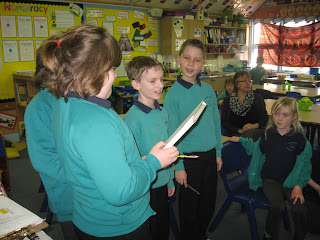 Year 4 market research
 Year 6 designing a net
 Year 5 using measuring skills as part of making jam
All of the classes carried out some excellent market research and used their data handling skills. The activities showed how mathematics is an important part of everyday day and the children enjoyed using and applying their skills and understanding. The money raised will be donated to Comic Relief. Well done to everyone!
 Year 4 market research
 Year 6 designing a net
 Year 5 using measuring skills as part of making jam
Wednesday, January 30, 2013
Dancing Problems?
How many people were at the dance?
When they danced as couples one person was left over.
When they danced in threes one person was left over.
When they danced in fours one person was left over.
When they danced in fives one person was left over.

When they danced as couples one person was left over.
When they danced in threes one person was left over.
When they danced in fours one person was left over.
When they danced in fives one person was left over.
Monday, January 7, 2013
Researching Mathematics Provision
Recently children and teaching staff have used a research process known as the Nominal Group Technique to help identify how to children could do even better at maths. As part of the research the the participants thought how children could improve at maths and then voted for the ideas that they thought were the most important. The results were enlightening and have been used to target additional support.
Thursday, November 15, 2012
Displays
Some excellent displays have been made that celebrate children's learning and help support and enrich mathematics. These 'learning walls' are regulary used and updated.


Year One

Year Five

Reception
Cross Curricular Learning
In Year 3 the children enjoyed applying their mathematical skills as part of a 'Hansel and Gretel' topic. They looked into how long it would take bread to be eaten when laid out on a path outside just as Hansel and Gretel did in the traditional story. They collected the data and presented their findings in bar charts. Well done Year 3.


Monday, January 11, 2010
Mathematics Enrichment Afternoon
Recently a group of Blandford St Mary Primary School children enjoyed a 'Mathematics Enrichment Afternoon' at the Blandford School. Below you can see the impressive 3D map of Blandford and the surrounding area that children created. They did so by reading maps and transferring the data onto pieces of card that were glued together.


Wednesday, August 27, 2008
Tuesday, March 4, 2008
Parents Workshop Postponed!!
Oh no! Never mind - the workshop will be scheduled for some time later in the year. This post will give some links and information to help develop all of our skills in helping our children become more confident problem solvers.
Problem Solving
The first thing to try to remember is that maths and problem solving in particular has a dual-role. The first is that it is a tool for life. Many of the skills we teach and nurture are required in later life or at least provide the foundations for the jobs and roles the children will fulfill when they are older. Of course, the second role that maths has is maths for math's sake! It is a subject of immense beauty that can be enjoyed if you have the confidence required! The links here serve either one or both of the purposes mentioned.
 This picture shows a piece of work completed by a year 4 pupil. The lesson was an ICT lesson however the amount of 'maths' needed to complete the work is considerable. Angles, maths language, measurement, 2D shape etc. were all required before you could even think about this complex but exciting task. Just a quick example of what is required to solve problems in areas other than pure mathematics.
MathsNet Turtle allows you to complete this sort of thing online!
Some Links To Get You Started
Primary Resources - Some age-related tasks for you to complete with your children.
ATM - Some free resources (and some for those of you with older children)
DCSF Website - Government guidance on Problem Solving (2 downloads)
NRICH - Brilliant, colourful resources for problem solving at a range of levels.
In The Future
We are currently in the process of designing some small videos to share on our website that show some of the techniques we employ at school to help with developing our problem solving skills. Please look out for these later in the year.
Thanks
Mr Lavis
Problem Solving
The first thing to try to remember is that maths and problem solving in particular has a dual-role. The first is that it is a tool for life. Many of the skills we teach and nurture are required in later life or at least provide the foundations for the jobs and roles the children will fulfill when they are older. Of course, the second role that maths has is maths for math's sake! It is a subject of immense beauty that can be enjoyed if you have the confidence required! The links here serve either one or both of the purposes mentioned.
 This picture shows a piece of work completed by a year 4 pupil. The lesson was an ICT lesson however the amount of 'maths' needed to complete the work is considerable. Angles, maths language, measurement, 2D shape etc. were all required before you could even think about this complex but exciting task. Just a quick example of what is required to solve problems in areas other than pure mathematics.
MathsNet Turtle allows you to complete this sort of thing online!
Some Links To Get You Started
Primary Resources - Some age-related tasks for you to complete with your children.
ATM - Some free resources (and some for those of you with older children)
DCSF Website - Government guidance on Problem Solving (2 downloads)
NRICH - Brilliant, colourful resources for problem solving at a range of levels.
In The Future
We are currently in the process of designing some small videos to share on our website that show some of the techniques we employ at school to help with developing our problem solving skills. Please look out for these later in the year.
Thanks
Mr Lavis
Friday, January 18, 2008
Challenging Maths!
Once a week some mathematicians get together from year 6 year 5 and year 4 to do some thinking maths, we do lots of sheets of work. Some are really hard and some are really easy.
Today we had to do two number puzzles and one Tennis puzzle.It is very fun to do. Working together is good to share ideas and information - working with each other is challenging!
By Sophie-Louise Bridges and Luke Powell.
Today we had to do two number puzzles and one Tennis puzzle.It is very fun to do. Working together is good to share ideas and information - working with each other is challenging!
By Sophie-Louise Bridges and Luke Powell.
Tuesday, January 8, 2008
A New Year and New Diligence
Happy new year to all!
Please keep coming back to this blog as there will be regular updates to it from now on and all of the updates should be pertinent to teaching and learning.
At the side of the blog should be some regular links but also some up-to-date videos and articles that will be of use to you as a teacher, parent or even as a pupil.
The Progression of Calculation

In preparation for an upcoming staff meeting on 29th January- it would be useful if you could have a look at the Primary Framework site pages on calculation and its progression
alternatively, you could download the article here and print it off.
Abacus Evolve

There are some useful documents at Abacus that link the Abacus Evolve objectives to the Primary Strategy objectives. This might help you find some resources to use if you are not using Abacus as the basis of your planning.
Please keep coming back to this blog as there will be regular updates to it from now on and all of the updates should be pertinent to teaching and learning.
At the side of the blog should be some regular links but also some up-to-date videos and articles that will be of use to you as a teacher, parent or even as a pupil.
The Progression of Calculation

In preparation for an upcoming staff meeting on 29th January- it would be useful if you could have a look at the Primary Framework site pages on calculation and its progression
alternatively, you could download the article here and print it off.
Abacus Evolve

There are some useful documents at Abacus that link the Abacus Evolve objectives to the Primary Strategy objectives. This might help you find some resources to use if you are not using Abacus as the basis of your planning.
Subscribe to:
Posts (Atom)